EXE PO 2026: IT-alert tests on June 25–26 simulate two major dam collapses
The tests will involve two dams in Piemonte, Lombardia, and Veneto, during the national flood risk exercise in the Po River basin

From Thursday, June 25 to Saturday, June 27, 2026, the Civil Protection System will be involved in the national exercise “EXE PO 2026,” which focuses on the management of hydrogeological and hydraulic risk across the entire Po River basin and involves the Regions of Piemonte, Lombardia, Emilia-Romagna, and Veneto.
The exercise will test the operational response of the National Civil Protection Service in the event of an exceptional flooding of the Po River—a complex meteorological and hydrological scenario on an interregional scale—through both field activities and command-post exercises, assessing communication flows, response models, national and regional alert systems, and coordination among the various institutional levels.
At the same time, the IT-alert system will be tested for the specific risk of “major dam failure” in the areas surrounding the Porto della Torre Dam (VA), located between the municipalities of Somma Lombardo in Lombardia and Varallo Pombia in Piemonte, and the Salionze Dam (MN), in the province of Mantova, located between the municipalities of Monzambano and Ponti sul Mincio.
The tests are scheduled as follows:
JUNE 25, 2026 - 3:30 PM - Porto della Torre Dam (VA)
Municipalities involved: Somma Lombardo, Vizzola Ticino, Lonate Pozzolo (in the Province of Varese);
Varallo Pombia, Pombia, Marano Ticino, Oleggio, Bellinzago Novarese (in the Province of Novara)
JUNE 26, 2026 - 2:00 PM Salionze Dam (MN)
Municipalities involved: Mantua, Volta Mantovana, Monzambano, Ponti sul Mincio, Goito, Marmirolo (in the Province of Mantua);
Valeggio sul Mincio (in the Province of Verona)
On Thursday 25 and Friday 26, residents in the areas affected by the tests will receive this message:
TEST TEST This is an IT-alert TEST MESSAGE. There is an ongoing SIMULATION of a dam collapse in the area where you are. To learn what message you will receive in case of real danger and to fill out the survey, go to www.it-alert.gov.it/en TEST TEST
Periodically testing IT-alert is essential to verify that, in the event of a real emergency, the phone cells in the affected area provide the necessary coverage, and to ensure the efficiency of the communication flows defined in the Civil Protection Document and the Dam Emergency Plan (PED).
“EXE PO 2026” will serve as an important training opportunity for civil protection operators, technicians, and volunteers, as well as a means of further raising awareness among residents living in areas adjacent to the Po River. This type of initiative makes it possible to involve all citizens—particularly people with disabilities, older adults, and those less familiar with digital tools—in a non-emergency context that simulates real-life conditions. To this end, it will be important to complete the survey that will be made available after the test message is sent, thereby helping to collect useful information on how the alert was received.
"Collapse of a large dam" refers to the collapse of the dam structure itself or the occurrence of damages to the dam or landslides that lead to the uncontrolled release of water, such as to reasonably assume the occurrence of a catastrophic event, which generally causes a flood wave and the subsequent flooding of downstream areas. Large dams are regulated by the Directive of the President of the Council of Ministers of July 8, 2014, on "Operational guidelines concerning civil protection activities within basins where large dams are present."
When a risk related to the structural strength of a large dam occurs, it is referred to as "dam risk," which entails four alert phases (pre-alert, reinforced alert, danger, and collapse).
Each dam is required to have a Civil Protection Document (DP), which defines the specific conditions for the activation of the civil protection system, communications, and technical-administrative procedures to be implemented in case of risk, and a Dam Emergency Plan (DEP), which outlines the areas potentially affected by the flood wave, operational strategies, and the intervention model to face the emergency.
IT-alert would be activated in case of collapse of a large dam, that is, a retaining structure exceeding 15 meters in height or resulting in a reservoir volume exceeding 1,000,000 cubic meters.
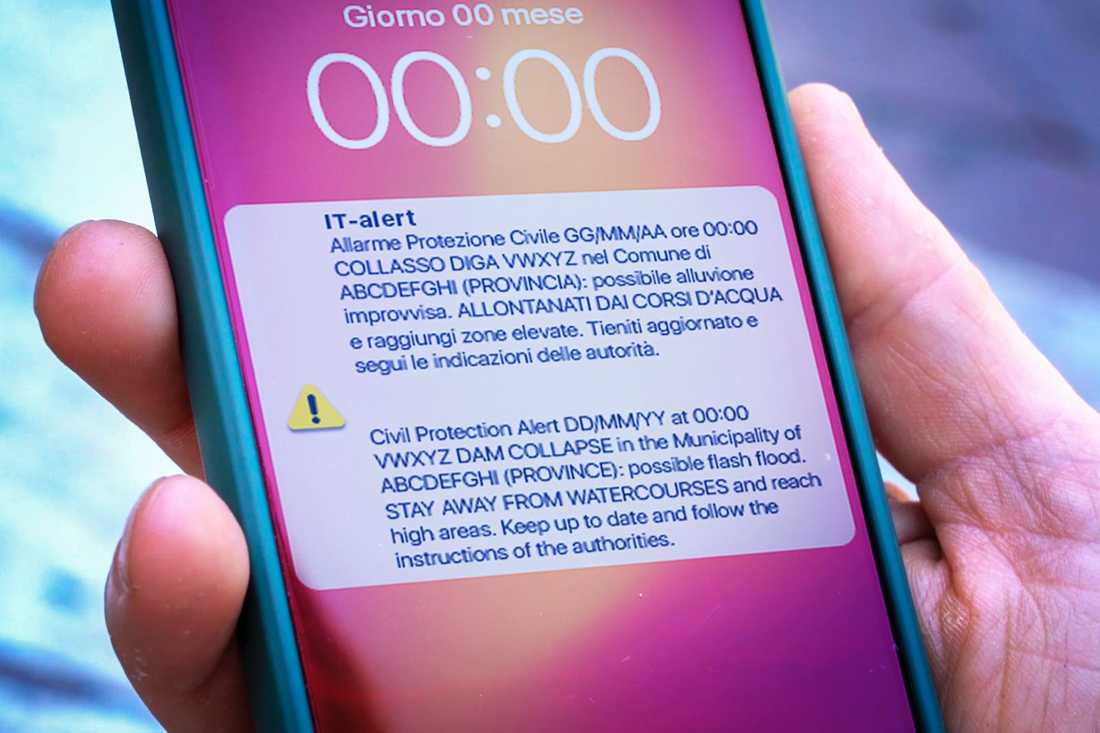
In case of real danger from a large dam collapse, cell phones in the municipalities potentially affected by the flood wave will receive such an IT-alert message:
▪ Civil Protection Alert DD/MM/YY at 00:00 - XYZ DAM COLLAPSE in the Municipality of XYZ (PROVINCE): possible flash flood. STAY AWAY FROM WATERCOURSES and reach high areas. Keep up to date and follow the instructions of the authorities.
However, there may be devices present in areas affected by the emergency that will not receive the message. This is caused by one of the limits of cell-broadcast technology: the impossibility of perfectly overlaying the area potentially affected by the emergency with the area covered by the antennas of the telephone operators used to send the messages.